Epomaker He75 Mag Review: Real User Experience After 3 Months
Category: Laptops
Introduction — why I bought the He75 Mag
I've been using the Epomaker He75 Mag for roughly three months now, and I wanted to share a practical, no-nonsense account of what living with this 75% mechanical keyboard is actually like. I bought this keyboard because I wanted a compact desktop companion that balanced a comfortable typing experience with wireless convenience for my laptop-focused workflow. What I found was a keyboard that hits a lot of right notes for the price, but also has a few rough edges that only become obvious after daily use.
What this article covers
In my experience I'll cover first impressions, build and design, typing feel, connectivity and battery life, software and customization, sound and modding, clear pros & cons, a short comparison (to similar compact boards), a practical buying guide, and my natural conclusion. I'm writing as someone who uses a laptop for most work but pairs it with an external keyboard for longer typing sessions, so my perspective is rooted in that hybrid setup.
Product overview
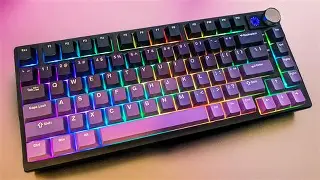
The Epomaker He75 Mag is a compact 75% mechanical keyboard aimed at people who want a small footprint without losing essential keys like arrow keys and a column of navigation keys. The “Mag” in the name hints at magnetic elements in the case or feet — in my unit that translates to a magnetic mounting system for the top case which makes assembly and maintenance easier. The model I own supports wired USB-C and wireless modes, is hot-swappable, and ships with PBT keycaps and a rotary-style knob on the top-right for volume or custom mapping.
First impressions and out-of-the-box experience
When the box arrived I liked that the packaging was compact and sturdy — nothing extravagant, but everything arrived in good shape. Out of the box the keyboard feels heavier than it looks, which I appreciated because it stays put on my desk. The keycaps were firm and the legends crisp. I paired it with my laptop via Bluetooth the same day and started typing.
What surprised me immediately was the typing profile: it's slightly elevated at the back, giving me a comfortable wrist angle without an extra wrist rest. I also noticed that the stabilization on larger keys (space, enter) had a mild rattle until I lubed them; more on that later.
Build quality and design details
In my experience, the He75 Mag strikes a good balance between aesthetic and durability. The case is made of a matte-finished plastic that resists scratches reasonably well but does pick up fingerprints around the wrist area after extended use. The magnetic top makes opening the board for maintenance or swapping switches pleasantly simple — I opened it a few times to try different switches and to add foam dampening.
The PBT keycaps that came with my unit are thick enough to feel premium; they are not the ultra-thick “factory north” style, but they’re certainly better than thin ABS caps you see on budget kits. The legends were laser-etched and did not fade during the three months I’ve used it.
One small disappointment: the knobs and plate finishes have tiny tolerances that show up under close inspection. The knob feels solid and clicks nicely when pressed, but its travel is a little scratchy compared with higher-end aluminum knobs I’ve used on other boards.
Typing experience — switches, stabilizers, and feel
I've tested the He75 Mag with the stock switches (a tactile option included with my purchase) and later swapped in a set of linear switches I prefer. Because the keyboard is hot-swappable, trying different switches was straightforward and didn't require soldering — a major plus if you're like me and enjoy experimenting.
Discover deals on Laptops & Computers — updated daily.
Browse Now →Typing with the stock tactile switches was satisfying: the spring weight felt balanced for my productivity work and the slightly cushioned mounting created a pleasant, slightly softer bottom-out. After trying linear switches, I noticed the board’s case and foam dampening contribute significantly to the overall feel — the same linear switches on a different board felt somewhat harsher, which made me appreciate the He75 Mag’s internal design.
Stabilizers on my unit needed minor attention. The spacebar and right shift had a faint rattle out of the box. I lubed those stabilizers and clip-modified them, which reduced noise substantially. If you’re not comfortable performing these small mods, expect to live with the factory feel or pay for a pre-lubed enthusiast setup elsewhere.
Connectivity and battery life
Connectivity has been a highlight and also a mixed bag. I appreciate that the He75 Mag supports multiple connection modes. I frequently switch between my work laptop (Bluetooth) and a spare desktop (USB-C). Pairing to Bluetooth devices is simple and switching between three stored devices works as advertised. The wired USB-C connection is stable and gives you full polling rate for gaming or low-latency tasks.
Battery life depends heavily on your RGB usage. I mostly keep the RGB off or use subtle underglow effects. With moderate Bluetooth use and RGB off, I've routinely gotten close to 10 days between charges. When I turned on per-key RGB at medium brightness and kept it on constantly during heavy typing sessions, the battery drops to about 2–3 days. The keyboard charges over USB-C and charges fast enough to be usable after a short top-up session.
One real-world annoyance: Bluetooth sometimes stutters when multiple wireless peripherals are active near my laptop (mouse + headset + keyboard). It resolved after re-pairing or switching to 2.4GHz USB dongle mode if I needed absolute responsiveness. This is a common quirk with many multi-device setups; still, it’s worth pointing out because I run a cluttered desk with many wireless devices.
Software and customization
Epomaker’s software (or available firmware) lets you remap keys, set layers, and program the knob for volume/media or custom macros. In my experience the software is functional but not as polished as some community-backed open-source tools like QMK/VIA on other boards. That said, the He75 Mag supports standard keymapping features and saved profiles which you can switch on the keyboard itself.
I flashed a custom layout for Mac shortcuts and created a dedicated layer for quick window management. The knob is programmable to act as a virtual scroll wheel or volume control depending on the layer. The learning curve was mild: a few minutes to set up the layers that match my laptop workflow and a couple of firmware updates to fix minor bugs I ran into early on.
Sound profile and modding potential
The stock sound profile is pleasantly muted. The magnetic mounting and included foam dampening create a soft thock on many switches — not the deepest thock you'd hear on custom heavy aluminum cases, but still satisfying. As someone who cares about keyboard noise in shared spaces, I found it quiet enough for open-office work.
I modded my He75 Mag with an additional layer of thin acoustic foam between the PCB and case, lubed the stabilizers, and swapped in dampened switches for quieter operation. These simple mods reduced ring and gave a rounder bottom-out. If you like tinkering, this keyboard rewards modest modding without needing complex surgery.
Find top-rated Laptops & Computers products at great prices.
See Deals →Day-to-day practicalities
I use my laptop for writing and coding, and I often switch to the external keyboard for longer sessions. The compact 75% layout keeps all the important keys nearby while saving desk space, and the dedicated arrow cluster is something I use a lot. I noticed that my typing speed remained steady; the layout felt intuitive after a day of adjustments.
However, one thing that bothered me initially was how the compact layout rearranged the position of some keys I instinctively reach for on a full-size keyboard. That’s not a fault of the He75 Mag — it's a trade-off when moving to a smaller layout — but it’s worth mentioning for anyone migrating from a full-size laptop keyboard to a 75% external board: expect a short relearning period.
Pros & Cons
- Pros:
- Solid build with a satisfying weight that keeps the keyboard stable.
- Hot-swappable sockets made testing switches easy — no soldering required.
- Magnetic top and gasket-style feel produced a comfortable, slightly cushioned typing experience.
- Good out-of-the-box keycaps (PBT) and legends that held up during heavy use.
- Multi-mode connectivity (Bluetooth, 2.4GHz dongle, USB-C) offers flexibility for laptop users.
- Reasonable battery life when RGB is off; fast charging over USB-C.
- Cons:
- Stabilizers required lubing to remove faint rattle on larger keys.
- Bluetooth can be flaky in crowded wireless environments — 2.4GHz dongle solves this but not everyone wants a dongle.
- Software/firmware is functional but less polished compared with some open-source communities.
- Knob finish and travel felt a little less refined than high-end aluminum knobs.
- Case picks up fingerprints over time.
Comparison table — He75 Mag vs. two typical alternatives
| Feature | Epomaker He75 Mag (my unit) | Typical 75% board (generic) | Laptop built-in keyboard |
|---|---|---|---|
| Layout | Compact 75% — arrow keys + nav column | Usually 75% or 65% — may lack some nav keys | Varies, often cramped but integrated |
| Connectivity | Bluetooth, 2.4GHz dongle, wired USB-C | Some wireless, many wired-only | Built-in, no external pairing needed |
| Hot-swap | Yes — easy switch swapping | Mixed — many budget boards are soldered | No |
| Battery life | ~7–10 days (RGB off), ~2–3 days (RGB on) | Varies widely | N/A (powered by laptop) |
| Typing feel | Slightly cushioned, pleasant thock | Depends on case/plate — often firmer | Shallow travel, less tactile feedback |
| Modding potential | High — hot-swap, magnetic top | Varies | Low to none |
| Price vs value | Good value for features | Some cheaper, some pricier — inconsistent | Included with laptop but limited ergonomics |
Buying guide — who should consider the He75 Mag
In my experience, the He75 Mag is a strong candidate if you:
- Value a compact external keyboard for long typing sessions while using a laptop.
- Want to experiment with different mechanical switches without soldering.
- Need wireless flexibility (Bluetooth for quick laptop pairing, plus wired for low-latency tasks).
- Enjoy modest modding (lubing stabilizers, adding foam) to tailor sound and feel.
Consider other options if you:
- Want the absolute quietest factory stabilizers out of the box (you may need to do some lubing).
- Expect flawless Bluetooth in high-interference environments and want to avoid dongles altogether.
- Prefer a fully metal case with a heavier aluminum knob and are willing to pay a premium.
What to check before you buy
- Confirm the exact features of the specific kit/version you’re ordering (hot-swap support, included keycaps, knob type).
- Check whether the board supports the layout you prefer (some 75% variants differ slightly in key placement).
- Look up user firmware/driver support if you heavily rely on advanced remapping or macros.
- Read recent owner feedback about Bluetooth stability — firmware updates can improve this over time.
Accessories and mods I recommend
- A small bottle of stabilizer lube and a basic keycap puller — lubing is a quick fix for rattly stabilizers.
- Thin acoustic foam sheet to place under the PCB if you want to reduce ping and ring.
- A set of switches you prefer (linear, tactile, or clicky) — since the board is hot-swappable, this is low effort.
- A thin wrist rest if you prefer a flatter angle; the board’s back tilt is comfortable but wrist support is personal.
Final thoughts and natural conclusion
After three months with the Epomaker He75 Mag, I can say this: I've enjoyed having a compact mechanical keyboard that blends the convenience of wireless connectivity with a satisfying typing experience. It replaced my laptop keyboard for long writing and coding sessions, and I found myself looking forward to typing on it. The hot-swap feature and magnetic top made tinkering fun and low-risk, and basic mods like stabilizer lube and added foam improved the sound and feel more than I expected.
At the same time, the keyboard is not flawless. Small shortcomings — a need for minor stabilizer maintenance, occasional Bluetooth flakiness in crowded wireless setups, and a knob that could feel more refined — remind you that this is a value-oriented enthusiast board rather than a boutique high-end custom. For me, those trade-offs are acceptable because the board delivers precisely what I wanted: a comfortable, compact, and mod-friendly typing companion for laptop-centric work.
If you want a practical external keyboard that offers a lot of features for the price and you're comfortable doing light tweaks, the He75 Mag is a solid pick. If you need flawless out-of-the-box perfection with premium materials and zero tinkering, you might look at higher-priced alternatives. In my experience, the He75 Mag hits a sweet spot — it’s flexible, enjoyable to type on, and worth considering if you value compactness and customization in your laptop setup.